

 Even if you aren’t a die-hard do it yourself type, there are a number of basic car maintenance tasks that you can probably do yourself. When you do your own car maintenance, you can save some money and not have to worry about finding a mechanic available when it works for your busy schedule. For maintenance tasks that are too difficult for you to manage on your own, you can always call your Florida Kia service department and schedule an appointment. Here are some tips for tasks you can probably do on your own:
Common Car Maintenance People Can Often Do Themselves
There are some car maintenance tasks that you can do with little or no experience if you take the time to review the instructions or even a “how to” video online. Here is a short list of possible projects you could do yourself to save money and gain car maintenance experience:
Replacing Windshield Wipers – If the rubber pieces on your windshield wipers are starting to show wear and tear, or the wipers are not keeping your windshield clear when it rains or snows, it is time to replace the wipers. Purchase the correct wipers for your car, and then follow the instructions to replace them.
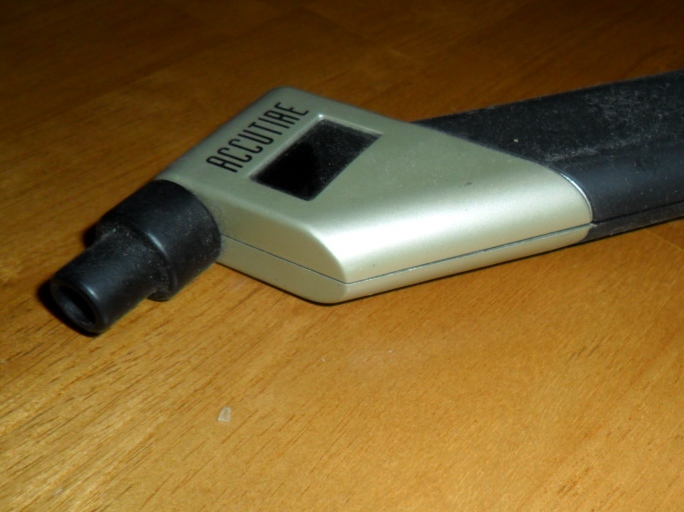
Check Tire Pressure – if you have a vehicle that doesn’t tell you what your tire pressure is in the dashboard information center, then get a tire gauge. You can check the pressure in your tires whenever it seems low and add air as necessary.
Replacing Car Battery – all car batteries eventually need to be replaced. You can disconnect and remove the old battery and just slide a new one into position and reconnect. Just pay attention to disconnect and reconnect in the proper order: remove negative battery cable first when taking out the old battery and when you reconnect the new battery, start with the positive cable.
Be Prepared with a Car Maintenance Kit
If you plan to start doing some of your own car maintenance, you should put together a car maintenance kit so you have the necessary supplies when you need them. It’s very frustrating to start a project only to discover you need to go to the auto parts supply store before you can do the work.
Here’s a list of items to keep in your car maintenance kit, so you are ready for most do-it-yourself jobs you might come across:
- Multiple wrenches in various sizes and/or an adjustable wrench
- Various sizes of screwdrivers, Phillips and flat
- Tire pressure gauge
- Pliers
- Jumper cables and/or a jumper box
- Work gloves to protect your hands
- Dry and clean rags
![[Facebook]](https://www.crownkia.com/blogs/370/wp-content/plugins/bookmarkify/facebook.png)
![[LinkedIn]](https://www.crownkia.com/blogs/370/wp-content/plugins/bookmarkify/linkedin.png)
![[Twitter]](https://www.crownkia.com/blogs/370/wp-content/plugins/bookmarkify/twitter.png)
![[Yahoo!]](https://www.crownkia.com/blogs/370/wp-content/plugins/bookmarkify/yahoo.png)
![[Email]](https://www.crownkia.com/blogs/370/wp-content/plugins/bookmarkify/email.png)
 The 2013 Kia Rio is a subcompact car that doesn’t sacrifice style or equipment in exchange for its tiny size. You can fit three passengers comfortably despite its small size, and you’ll appreciate the exceptional fuel efficiency of this vehicle. To increase fuel efficiency even more, you can upgrade to the automatic stop and start technology. In addition to fuel efficiency and comfort, the Kia Rio has performed well in various safety ratings and offers top of the line safety features to keep you and your family safe on the roads. Your Largo area Kia dealer discusses the 2013 Kia Rio safety ratings and features:
Insurance Institute for Highway Safety Ratings
The Insurance Institute for Highway Safety (IIHS) provides safety ratings for vehicles based on how they perform in high speed front and side crash tests. They are an independent, educational and nonprofit organization that is on a mission to reduce deaths and injuries from car crashes in the United States. The ratings can be “good”, “acceptable”, “marginal” or “poor”. The 2013 Kia Rio receives the following performance ratings:
- Right Leg/foot: good
- Left Leg/foot: good
- Restraints: good
- Overall front: good
- Chest: good
- Structure/safety cage: good
2013 Kia Rio Safety Features
The following safety features are included on the 2013 Kia Rio:
Anti-lock brakes: if the tires stop rotating with the brakes pressed, the anti-lock brake system will engage and modulate the pressure on the brakes that allow the tires to rotate while slowing down. This gives the driver more ability to maintain control and turn the car while braking and prevents uncontrollable slides caused by locking brakes.
Stability control: if the handling limits of the Kia Rio have been exceeded, the stability control system will kick in and reduce power to the engine or apply brakes to help prevent the loss of control of the vehicle.
Front-impact airbags: the driver and passenger’s heads are protected in the front seats with front airbags that engage when accidents involve the front of the vehicle.
Side impact airbags: the driver and passenger will be protected from side impact accidents with airbags that protect the torso.
Overhead airbags: airbags above the head will engage if the car is hit from the side or is involved in a rollover accident to help protect the driver and passenger’s heads.
Seatbelt pretensioners: when necessary, the seatbelts will automatically tighten around the driver or passengers to ensure the individual is seated correctly to prevent injury during a collision.
Anti-whiplash head restraints: the heads of the driver and passenger will be protected by anti-whiplash head restraints when the car is hit from behind to reduce the potential for whiplash injuries.
The 2013 Kia Optima at St. Petersburg Kia
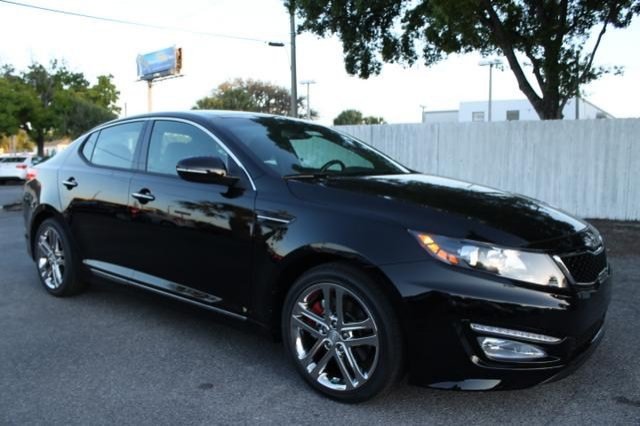 When the Kia Optima was redesigned in 2011 it was considered one of the best looking vehicles in the mid-size sedan class! The 2013 Kia Optima maintains the sophisticated appearance and offers improved handling and new drivetrains. If you are interested in test driving the 2013 Kia Optima or learning more about its features, visit your St. Petersburg Kia dealership.
2013 Kia Optima Interior Features and Appearance
Inside, the Kia Optima has a classic appearance and a wide rectangular control area slightly turned toward the driver for ease of reach and use. It has a somewhat minimalist appearance, like a cockpit almost.
The backseat can fit three people, although watch your head getting in and out as the slope of the roofline can be a challenge for some passengers. If you want to make your ride even more comfortable, you can upgrade to heated front and back seats.
Performance and Power
All versions of the 2013 Kia Optima have a four-cylinder engine, but the different versions each offer something different for different types of drivers. The base model offers a 2.4 liter, 4 cylinder engine with direct injection. It provides 200 hp and rides quietly. You can choose a 6 speed automatic or 6 speed manual.
The 2013 Kia Optima Hybrid combines the 4 cylinder engine with an electric motor and battery. All powertrains provide at least 33 miles per gallon in turbos on the highway, with the hybrid reaching 39 miles per gallon.
With any engine option for the Kia Optima you will have a smooth ride that handles well, and the suspension offers a quick and lively feel as you navigate the roads.
Features and Options
In addition to the possible heated front and back seats, you can also choose to add a rearview camera if you would like to decrease your blind spots when backing up. All 2013 Kia Optima vehicles come with a Bluetooth interface as a standard option, along with power features, satellite radio, a USB port and cruise control.
The EX trim level adds dual-zone climate control and a smart-key system. At this trim level, you have the option of leather trimmed seats, Infinity audio and a panoramic sunroof.
Visit St. Petersburg Kia
If you want to see the 2013 Kia Optima for yourself or even take it for a test drive to see whether or not it will reach your needs – stop by our St. Petersburg Kia dealership. The best way to find out if a car is for you is to drive it.
 The majority of US teenagers cannot wait until they are old enough to get behind the steering wheel. They see driving as their ticket to freedom. The parents of teenagers, on the other hand, often dread the day when their baby is old enough to drive around town on their own and are concerned for their safety. Parents are also torn over whether or not their teenager should pay for their own car and insurance, or if they should pay for it for them. Your Pinellas Park area Kia dealership offers the following advice for keeping teenagers safe on the roads and what to do about cars and insurance:
Safety Starts With Good Examples
If you want your teenagers to make good decisions when it is their turn to drive, you need to make safe driving decisions when they’re in the car with you. They are watching and learning driving habits long before they’re old enough to drive themselves, even if you think they aren’t paying attention. Don’t use your cell phone while driving, don’t experience road rage, and obey speed limits and driving laws if you hope your teenagers will do the same.
Driving Practice
Don’t send your teenagers out on the road without adequate driving practice. It is only by experiencing different driving situations that they learn what to do in those situations. Have your teenager drive with you in the car as often as you can before they get their license or have permission to drive alone, so you can point out what they’re doing correctly and what they need to improve. Try to give your teenager experience driving on country roads, in the city, on the highway, and have them practice parking, three-point turns, and backing up.
If your schedule doesn’t allow for a lot of time driving with your teenager, enroll them in a driving course so they get to drive with an experienced driver.
Cars and Car Insurance for Teenagers
Some parents want their teenagers to learn financial responsibility and feel the car and car insurance is a good place to start. Others feel they will have their entire adult lives to worry about finances and that they should provide the car and insurance for the teenager. Regardless of the decision you make, keep in mind that many car insurance companies will provide discounts to students who demonstrate good grades. While having your teen pay for his or her own insurance and/or car can be a good life-lesson, the disadvantage is it will require your teenager to work and the part time job around school hours may interfere with their ability to participate in sports or extracurriculars often necessary for college admissions.
 Buying a new car is generally one of the biggest investments you will make. If you’re going to spend a significant amount of money on a purchase, you will want to take the time to research the purchase and ensure you understand the financing agreement before you sign a contract. The financing terms will vary from one lender to another, depending on if you finance your new car purchase through a dealership, a bank, credit union, or third party lender but the basic concepts are the same. Here are some tips from your Clearwater area Kia dealer for understanding the common car financing terms and making sure you make a good decision on your investment:
Average Amount Paid for Cars in the United States
The price tag on cars depends on the make and model car you’re buying as well as whether you choose a new or used car. The Federal Trade Commission published the average cost for used cars in the United States are $15,000 while the average new car price tag is listed at $28,000. For the majority of car buyers, this means a loan is necessary to make the purchase.
Pre-Buying Research
The best car deals happen when buyers take the time to do their research before heading to the dealership. Before shopping, get a copy of your credit report from one or all three of the credit reporting bureaus. You can get one per bureau each year for free. Your credit report will give you a good idea for whether you have good or bad credit – and since your credit is a major factor in getting financing for a car loan you should know where you stand. If you have a ton of late payments and negative notations on the credit report, you probably will not qualify for a car loan, or if you do qualify – you’re going to pay a very high interest rate.
If you find errors in the reports you should take steps to correct the inaccuracies as it could be causing your credit score to be lower than it would be otherwise.
Car Loan Financing Terms
Make sure you understand the following car loan financing terms before you sign your name to the contract.
Loan Principal – the principal of a car loan is the amount you borrow, but it is less than what you will actually pay back over time due to the addition of interest and finance charges. The principal amount is reduced by the amount of your down payment and/or value of a trade-in vehicle.
APR (Annual Percentage Rate) – this is the rate of interest you are charged for the privilege of borrowing a car loan. It can range from 0% (ideal!) to double digit interest rates for individuals with poor credit.
Loan term – a term is how long you will repay the loan and generally ranges from one year to five years.
 As the warmer weather of spring and summer approach, it’s a great time to consider whether your car is in need of any maintenance tasks. Keeping up with the car maintenance needs of your vehicle offers a worry free drive and ensures you are as safe as possible on the roads. Here are several items from your Tampa Bay area Kia dealer to check before the weather gets uncomfortably hot:
Engine Fluids
Your vehicle needs an oil change every 3,000 to 8,000 miles, depending what you drive. Older vehicles needed oil changes every 3,000 miles or 3 months, but modern vehicles tend to go 6,000 to 8,000 miles before they need an oil change. Check your owner’s manual to find out the particular oil change schedule for your car and keep up with it. Don’t forget the oil filter, too.
Before driving your car, while the engine is still cold, check the level of your coolant. The tank will indicate the fill-line, and this is where your coolant should be. If you don’t have enough coolant, add some to ensure your car is not at risk of overheating. Check your vehicle’s owner manual for adding coolant as some cars require a mix of coolant with water.
The transmission, power steering and brake fluid should all be checked, too. If any of the fluids are below the recommended level, add more for optimum performance.
Hoses and Belts
If you can’t remember the last time your accessory drive belts were checked for fraying, cracking or general wear and tear – it’s probably time to schedule an appointment to have them checked. Coolant hoses should also be checked to ensure they aren’t too soft or showing signs of leakage. Call your Tampa Bay area Kia service department to schedule a checkup and maintenance on any of the hoses and belts as necessary.
Brakes
If you think your car is in need of new brakes, schedule an appointment to have them checked and replaced immediately. Your vehicle’s brakes are your first line of defense to avoid car accidents. You might notice it takes longer to slow down than it used to, or your steering wheel may shake when you slow down. These are all warning signs that your brakes need replacing. If you hear grinding or the sound of metal on metal, you may also need new rotors.
Tires
Take a look at all of your tires to check how much tread remains. If the tread is less than 1/8 of an inch, it’s time for new tires. If the tread looks good, you should probably rotate your tires as it should be done every 6,000 to 8,000 miles driven.
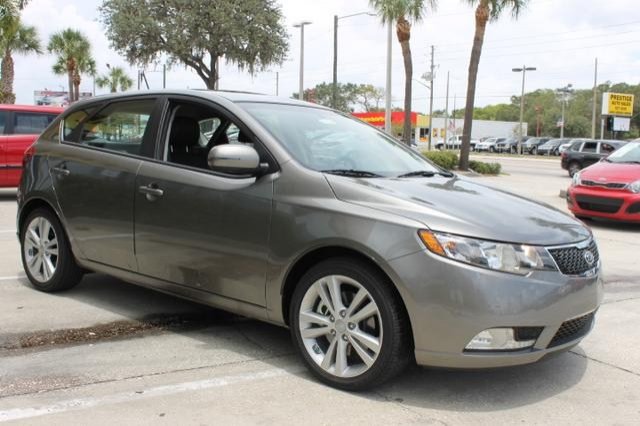 The 2013 Kia Forte 5-door has a few new additions that come standard, compared to the 2012 model. On the 2013 Kia Forte 5-door, you will receive power folding outside mirrors, LED daytime running lights and 16 inch alloy wheels on the SX trim. There is a washer fluid light in the dash now, to help you avoid running out of washer fluid just as you need it! The Forte 5-door is possibly being redesigned for 2014 and it is rumored that it will take on a more glitz and glam style. If you like the current Kia Forte, now is the time to visit your St. Petersburg Kia dealership and take it for a test drive before it is redesigned.
Power and Performance
The 5-door hatch Kia Forte does not struggle with power. There are two 4 cylinder engine choices, offering 156 horsepower in the 2-liter EX and 173 horsepower in the 2.4 liter SX engine.
The EX trim can get 27 miles per gallon in the city and 37 miles per gallon on the highway. The SX trim gets 23 miles per gallon in the city and 32 miles per gallon on the highway whether you choose the 6 speed manual transmission or the 6 speed automatic transmission.
2013 Kia Forte 5-Door Exterior Appearance
The Kia Forte 5-door is your basic hatchback vehicle and does not really contain any sportier looking design elements found on some of the competitors hatchback vehicles. For people looking for a family vehicle with a hatchback, this is an ideal fit. The door on the hatch provides easy access to loading all of your kid’s belongings, strollers, groceries or luggage for the family road trip in the cargo area. There is 19.4 cubic feet of cargo space in the Kia Forte 5-door.
The Kia Forte sits fairly low to the ground, which is great for small children to get in and out without too much assistance.
2013 Kia Forte 5-Door Interior Appearance
The real strengths of the Forte 5-door are in the interior. Many of the features are offered as standard inclusions, whereas other vehicles would charge extra for them as optional features. Driver’s report that the center console controls are all perfectly placed and easy to use while the upgraded models offer keyless entry and push-button start.
You can fit five passengers in the compact hatchback, but despite the limited seating the car does not feel small when you’re inside. The driver has plenty of room behind the steering wheel and the backseat can comfortably accommodate children in safety seats or adults with enough leg room. There are two cup holders in the front, two cup holders in the back, and even bottle shaped holders in the front door cutouts for your water or soda bottles.
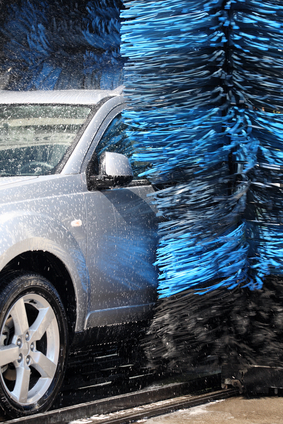 It’s important to keep your car clean and the automatic car wash is one of the easiest ways to keep up with the task. Convenience sometimes comes with a price, however, as an automatic car wash can cause physical damage to your vehicle. Most car washes are designed carefully and are well maintained to prevent damages, but there is always a possibility that the brushes will scratch the paint or the force of the water will damage something on your car. Here are some tips to avoid damage from automatic car washes from a Largo area Kia dealership:
Types of Damages from Automatic Car Washes
The most common types of damage from automatic car wash can be avoided with a few precautions. Before you go through the car wash, try the following:
- Put retractable antennas down before entering a car wash to avoid having them ripped off or bent during the car wash.
- If your side mirrors are loose, avoid automatic car washes which are likely to rip them off. If your side mirrors fold in, push them in before entering the wash.
- Remove all cargo from the roof racks as the force of the wash can push them off or break things.
- Only use well maintained car washes that have new brushes. Car washes with old brushes put you at risk for metal bristles or wires sticking out that will scratch your paint finish.
- Do not use an automatic car wash if you have any water leaking issues around your doors or windows. Don’t forget to make sure all windows are closed tight before entering the car wash.
Reducing Risks at Automatic Car Washes
When you drive your car, you put it at risk for scratches and damages and short of leaving your car secure inside a garage all the time – there is no foolproof way to prevent every possible opportunity for damage. If you can hand wash your car, then you eliminate all of the potential for automatic car wash damages but if you must use an automatic car wash – look for touch free versions that do not use brushes as these have less risks for damage to vehicles than car washes that use brushes to clean the dirt off your vehicle.
Kia History from St. Petersburg Kia Dealer
 Kia has a long and interesting history as an automobile manufacturer. In fact, Kia was founded in 1944 in Korea, and was called Kia Motors Corporation. In Korean, Kia means “to arise to the world from Asia”. The modern company of Kia is part of Hyundai-Kia Automotive Group, with dealerships all over the world – including your St. Petersburg Kia dealer in Florida. American Kia vehicles are sold under the brand name of Kia Motors America (KMA).
Kia is Worldwide
Kia is found all over the world, with more than 1.5 million Kia vehicles produced each year in over 13 manufacturing facilities located in 8 countries. There are Kia dealerships selling vehicles in 172 different countries.
Kia Motors America
In 1992, Kia Motors America was incorporated. They opened their first 4 dealerships in Oregon and began with the Kia Sephia. Soon after, Kia Sportage was introduced. Every year, Kia grew and dealerships were added in other states and by 1995, there were over 100 Kia dealerships in 30 states.
Financial Troubles for Kia
Asia experienced a financial crises in 1997, and it was during this time that Kia declared bankruptcy. Hyundai Motor Company purchased 51% of the company, winning in a bidding war with Ford Motor Company who had owned part of Kia since 1986 but Hyundai won out and took over in 1998. Over the years that followed, Kia recovered financially and Hyundai now owns less than half ownership of Kia.
Design Improvements Fuel Growth for Kia
In 2006, Kia decided they needed some new designs if they were going to continue to grow and succeed in the marketplace. They brought in a new Chief Design Officer who had won awards for his previous designs in Germany working for Volkswagen and Audi. Peter Schreyer began working with Kia in 2006 and oversaw design activities in Kia design centers located in Los Angeles, Tokyo, Germany and Korea. He was instrumental in the new look for Kia, and the establishment of the signature Kia look, the brand that is easily recognized by the “tiger nose” design of the front end of Kia vehicles.
Test Drive Kia Vehicles
You can learn more about any of our Kia vehicles and take them for a test drive to find the one that matches your needs perfectly. Visit your St. Petersburg Kia dealership for a test drive appointment or to learn more about Kia.
 For most drivers, getting a traffic ticket is not on the top ten lists of things to do! From speeding to tailgating to unsafe lane changes – you’re probably guilty of some of these habits at some point in time. There are several bad driving habits that are likely to get you a traffic ticket if there is a cop in the area – so follow these tips from a Pinellas Park area Kia dealer to help decrease your risks for getting a ticket:
Driving Too Fast
Sometimes speeding is unintentional and you don’t even realize how fast you’re going until you see the flashing lights of the cop behind you. Other times, you are purposely pushing the speed limits because you’re in a hurry to get somewhere. If you find yourself traveling faster than the posted speed limits, you can be pretty sure eventually you will be caught and find yourself paying a traffic ticket fine or facing the judge in court.
You can help prevent speeding when traveling on the highway by using your cruise control to set your speed. When driving through the city or residential areas, just remember to check your speed regularly and keep it under the posted limits to avoid a ticket. It’s better to get where you’re going a few minutes later than get into a car accident or end up with a speeding ticket.
Driving Too Close: Tailgating
When you drive too close to the vehicle in front of you, it’s called “tailgating”. Tailgating is a dangerous way to drive because it does not give you very much time to react if the car in front of you has to stop or turn unexpectedly for some reason. Tailgating usually ends up in a rear ending accident – or if a police officer sees a car tailgating, they may decide to give the driver a ticket for unsafe driving.
A good rule of thumb is to leave about a cars length for every ten miles per hour you’re driving. If traveling at 60 miles per hour, leave six car lengths between you and the car in front of you to give yourself adequate time to stop.
Changing Lanes Without a Turn Signal
Vehicles are equipped with left and right turn signals in order to let other drivers and pedestrians know what your intentions are. If you don’t use your turn signals when turning off a highway or changing lanes on a multi-lane highway, the drivers of the vehicles around you are not sure what you plan to do and a car accident is more likely.
Connect with us


Recent Blog Entries
Categories
 Warranties include 10-year/100,000-mile powertrain and 5-year/60,000-mile basic. All warranties and roadside assistance are limited. See retailer for warranty details.